


Blog / Article

eUICC vs. eSIM: What’s the Real Difference (and Why It Matters for Your IoT Fleet)
If you’ve spent any time researching connectivity for connected devices, you’ve probably seen “eSIM” and “eUICC” used as if they mean the same thing. They don’t — and for anyone building or scaling an IoT deployment, that distinction isn’t just semantics. It affects how you provision devices, how flexible you are with carriers, and how…
If you’ve spent any time researching connectivity for connected devices, you’ve probably seen “eSIM” and “eUICC” used as if they mean the same thing. They don’t — and for anyone building or scaling an IoT deployment, that distinction isn’t just semantics. It affects how you provision devices, how flexible you are with carriers, and how much manual work your team ends up doing down the line.
At Velos IoT, we get asked about this constantly, so let’s clear it up properly.
What is eSIM, Really?
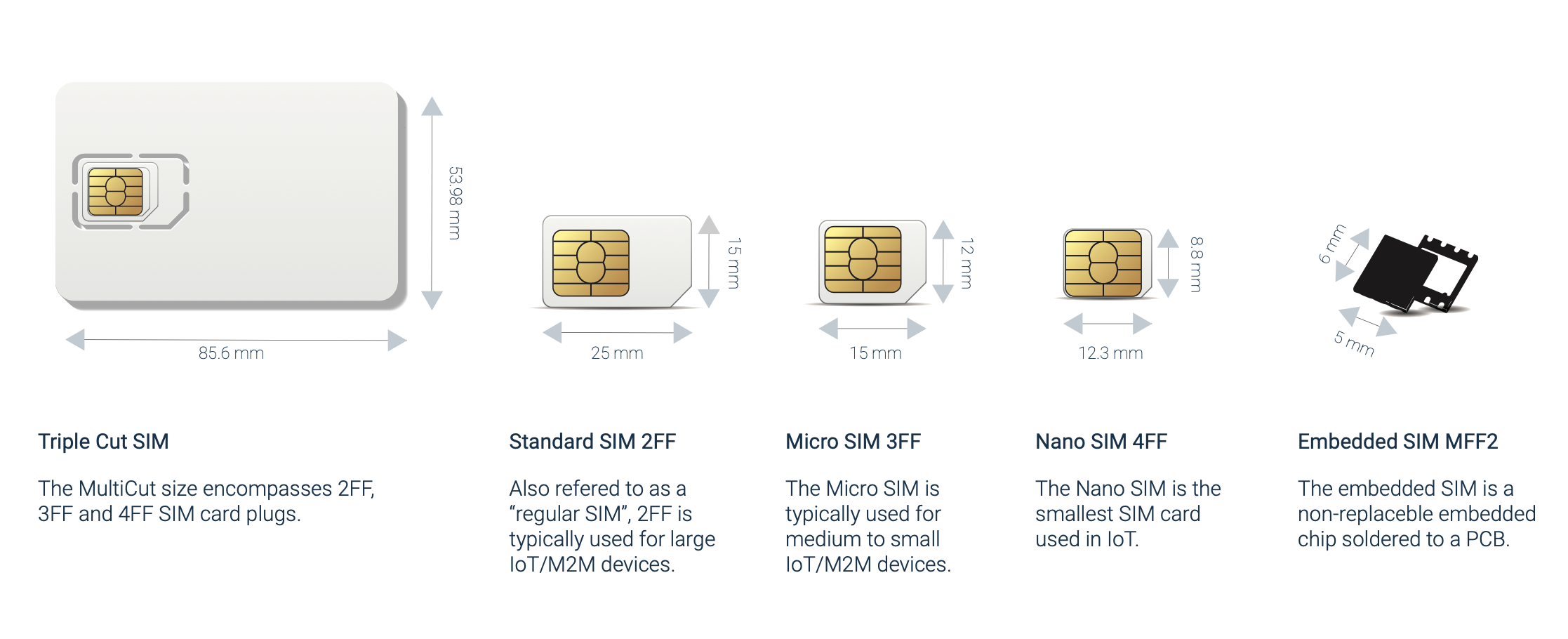
SIM stands for Subscriber Identity Module — the component that lets a network recognize and authenticate a device. The physical card has gone through several generations: the credit-card-sized 1FF, followed by the mini-SIM (2FF), micro-SIM (3FF), and today’s nano-SIM (4FF). For IoT specifically, there’s also the MFF2 — a chip soldered directly onto the device’s circuit board, built to survive vibration, heat, and the other harsh conditions industrial deployments throw at it.
Here’s where the confusion usually starts: people assume MFF2 (the embedded, soldered-down hardware) and eSIM are the same thing, simply because both get called “eSIM” informally.
The clearer way to think about it:
eSIM is the complete service — the SIM hardware, the eUICC software running on it, and the platform that manages everything remotely. It’s the whole ecosystem, not a single part.
What is eUICC?
eUICC (Embedded Universal Integrated Circuit Card) is the software layer inside that ecosystem — specifically, the piece that makes remote provisioning possible. It’s what lets you load, switch, or delete network operator profiles on a SIM without ever physically touching the device.
Crucially, eUICC isn’t tied to any one form factor. It can live on a nano-SIM, an MFF2, or any other SIM package. So a device with a removable SIM slot — like plenty of consumer phones — can still run eUICC and offer eSIM functionality alongside a traditional plan.
In short: eUICC is the engine; eSIM is the vehicle it powers.
eUICC vs. UICC: What Actually Changed
To see why eUICC matters, it helps to compare it with its predecessor, the UICC (Universal Integrated Circuit Card).
A standard UICC already does more than basic identification — it runs the SIM application, stores subscriber data, and manages mobile data and roaming across carriers. What it can’t do is change network profiles remotely.
That’s the gap eUICC closes. With an eUICC-enabled SIM, operators can push, swap, or remove network profiles over the air (OTA) from a centralized platform — no site visits, no manual SIM swaps, no device downtime. For a fleet of ten devices, that’s convenient. For a fleet of ten thousand deployed across multiple countries, it’s the difference between a scalable business and an operational bottleneck.
Why This Distrinction Matters for Your Business
If you’re an IoT service provider, OEM, or enterprise deploying connected devices at scale, understanding eUICC vs. eSIM isn’t academic — it shapes real decisions:
- Carrier flexibility: eUICC lets you avoid vendor lock-in by switching network profiles remotely as coverage needs or costs change.
- Global deployment: Devices shipped to any region can be provisioned with local or regional profiles after they’ve already left the warehouse.
- Operational efficiency: Fleet-wide profile updates happen instantly and remotely, cutting the cost and delay of manual intervention.
- Future-proofing: As your device footprint grows, an eUICC-based architecture scales without redesigning your connectivity strategy from scratch.
How Velos IoT Fits In
This is exactly the problem our ULTIMATeSIM solution is built to solve. It delivers reliable, secure global connectivity purpose-built for IoT service providers, OEMs, and large enterprises — combining top-tier coverage from leading carrier networks with the flexibility of eUICC-based remote provisioning, across whichever SIM form factor your devices need.
Whether you’re managing a handful of pilot devices or a global fleet, ULTIMATeSIM gives you the tools to provision, monitor, and manage connectivity without being tied to a single carrier or a single form factor.
Want to see it in action? Reach out to one of your IoT experts and test global eSIM connectivity on your own devices.
FAQs
Key questions related to eUICC vs eSIM
No. eSIM refers to the entire connectivity service — the SIM hardware, the eUICC software, and the management platform combined. eUICC is specifically the software component within that service that enables remote provisioning.
eUICC enables over-the-air (OTA) provisioning, meaning network operator profiles can be added, switched, or deleted remotely on a SIM without physically accessing the device.
Not exactly. MFF2 is a physical form factor — a SIM chip soldered onto a device’s circuit board. eSIM is a service that can run on MFF2 or on other form factors, including removable SIM cards.
Yes. As long as the SIM includes eUICC software, a device with a physical, removable SIM slot can still support eSIM functionality alongside a standard carrier plan.
For fleets deployed across regions or countries, eUICC removes the need for manual SIM swaps. Operators can manage network profiles remotely at scale, reducing downtime and operational cost as the fleet grows.
Related Articles
With 20+ years of experience in delivering complex IoT services, we understand the importance of world-class connectivity and security. We enable businesses worldwide, including IoT connectivity providers, to build and manage their mission-critical devices.


