Blog / Article

Smart HVAC Systems: How IoT Cuts Energy Costs and Downtime
A smart HVAC system is a heating, ventilation and air conditioning setup with IoT sensors, distributed control boards and network connectivity built in. It lets you monitor and control temperature, humidity, airflow and energy use remotely — and flags faults before equipment fails. The main gains are lower energy bills, fewer emergency call-outs and easier…
A smart HVAC system is a heating, ventilation and air conditioning setup with IoT sensors, distributed control boards and network connectivity built in. It lets you monitor and control temperature, humidity, airflow and energy use remotely — and flags faults before equipment fails. The main gains are lower energy bills, fewer emergency call-outs and easier regulatory reporting.
What is Smart HVAC?
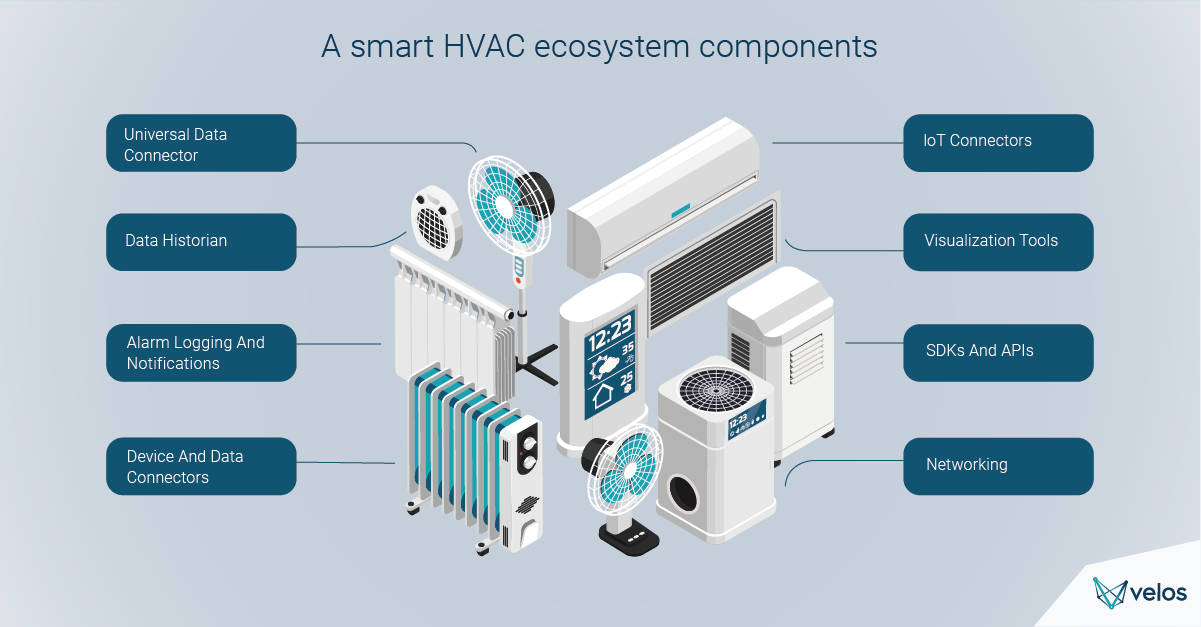
A smart HVAC system combines networked HVAC components with IoT technology, evolving from traditional Building Automation Systems (BAS). Occupants control room conditions — temperature, lighting, humidity, fan speed — from a smartphone or tablet instead of a wall panel.
The difference from a conventional system comes down to three things:
-
Data: sensors report conditions continuously, not just at the thermostat.
-
Control: intelligence sits across multiple components, not in one panel.
-
Access: the system is reachable remotely over cellular or Wi-Fi.
How does a smart HVAC system work?
A smart HVAC system works by collecting real-time data from sensors on each component, transmitting it over a network to a cloud platform, and using that data to adjust operation automatically or on command. Four parts make this possible.
1. Sensors and control boards
Sensors and control boards are embedded in individual components. They process real-time data locally, execute algorithms, and communicate with the rest of the system.
2. Intelligent control systems
Traditional HVAC has a single control panel in the thermostat. Smart HVAC distributes control panels across the equipment, so the system adapts to changes both inside and outside the building.
3. Connectivity and IoT integration
Connectivity is the cornerstone. Cellular connectivity, geofencing and voice activation give users immediate control, while integration with an IoT platform enables remote monitoring and advanced programming.
4. Zoning technology
Zoning allows independent temperature control for different sections of a building. Without zoning, the system still runs efficiently by maintaining longer, steadier run cycles.
Smart HVAC vs traditional HVAC: what’s the difference?
|
Traditional HVAC |
Smart HVAC |
|
|---|---|---|
|
Control point |
Single thermostat panel |
Distributed control boards |
|
Access |
On-site only |
Remote via app or web portal |
|
Energy data |
Available after consumption |
Real-time |
|
Maintenance |
Reactive or calendar-based |
Condition-based, predictive |
|
Fault detection |
On failure or site visit |
Remote diagnosis via sensor anomalies |
|
Compliance reporting |
Manual paperwork |
Automated data recording and reports |
|
Zoning |
Limited or none |
Independent zone control |
What are the main IoT applications in HVAC?
The five highest-value IoT HVAC applications are preventative maintenance, energy efficiency, remote monitoring, regulatory compliance and recurring service plans.
Preventative maintenance
Reactive and schedule-based maintenance both lack real-time insight into system condition. IoT sensors enable a condition-based approach: data flows to a cloud platform, and when anomalies appear — reduced efficiency, excessive power draw, abnormal vibration — technicians diagnose remotely. Result: less downtime, lower service cost.
Energy efficiency
Sensors track consumption instantaneously rather than after the fact. They identify usage trends, factor in weather forecasts and regulate indoor climate accordingly — which also makes the system ready to participate in IoT-enabled smart grids.
Remote system monitoring and control
Through an app or web portal, homeowners, property managers and HVAC partners see leaks, pressure variations, vibration and temperature shifts as they happen. Technicians assess status without a site visit, so issues are resolved faster.
Regulatory compliance
Continuous monitoring and automated report generation replace manual documentation. Records are accurate, stored, and ready to demonstrate compliance with both government and corporate standards.
Recurring service plans
Remote monitoring means service calls happen only when needed. That cuts unnecessary site visits and opens up usage-based pricing models — a recurring revenue stream for HVAC service partners.
What should you consider before adopting smart HVAC?
Weigh four things: the upfront investment, projected energy savings, your specific building and usage profile, and the reliability of the connectivity underneath it all. Upfront cost is the most visible factor, but long-term savings in energy, comfort and maintenance typically outweigh it.
Connectivity deserves particular attention. A smart HVAC system is only as dependable as the network carrying its data — if devices drop offline, you lose the monitoring and remote control you paid for.
What’s next for Smart HVAC?
Smart HVAC is moving from a premium feature to a default one, driven by falling costs for residential and commercial users. Expect deeper integration with smart grids, so buildings contribute to energy efficiency across interconnected environments rather than optimising in isolation.
Ready to connect your HVAC fleet?
Smart HVAC only delivers when the devices stay online. Velos IoT provides secure, cost-effective global connectivity for HVAC deployments, managed from a single pane of glass.
[Talk to our team →] · [See the Nomad CMP product page →]
FAQs
Frequently Asked Questions regarding Smart HVAC Systems
For most commercial buildings and multi-property portfolios, yes — the savings come from avoided emergency repairs and reduced energy waste, not just convenience. For a single small home, the payback period is longer and depends heavily on local energy prices.
Often yes. IoT sensors and connectivity modules can be added to existing HVAC equipment to enable remote monitoring and condition-based maintenance, without replacing the units themselves.
No. Many commercial deployments use cellular connectivity instead, which avoids dependence on a building’s Wi-Fi network and keeps devices online during local network outages.
Typically temperature, humidity, pressure, vibration, power consumption, run cycles and fault codes — transmitted to a cloud platform for monitoring and analysis.
By shifting from scheduled or reactive servicing to condition-based servicing. Technicians are dispatched when sensor data indicates a real problem, which cuts unnecessary visits and prevents small faults from becoming failures.
Related Articles
With 20+ years of experience in delivering complex IoT services, we understand the importance of world-class connectivity and security. We enable businesses worldwide, including IoT connectivity providers, to build and manage their mission-critical devices.