


Blog / Article

Smart HVAC: How IoT Transforms Smart HVAC Systems
Your traditional HVAC system is costing you money. To save energy costs and also improve your comfort, adopting smart HVAC is the need of the hour. Smart HVAC systems, an evolution of traditional Heating, Ventilation, and Air Conditioning (HVAC) setups, are revolutionising the way we control and experience indoor climates. Leveraging the power of the…
Your traditional HVAC system is costing you money. To save energy costs and also improve your comfort, adopting smart HVAC is the need of the hour. Smart HVAC systems, an evolution of traditional Heating, Ventilation, and Air Conditioning (HVAC) setups, are revolutionising the way we control and experience indoor climates. Leveraging the power of the Internet of Things (IoT), these systems go beyond mere temperature regulation, offering a new level of granularity and efficiency. Let’s delve into the world of Smart HVAC.
What is Smart HVAC?
A Smart HVAC system integrates networked HVAC components and IoT technologies, representing the natural progression from conventional Building Automation Systems (BAS). The primary objective is to empower occupants to finely control room conditions, covering aspects such as temperature, lighting, humidity, and fan speed. Unlike traditional systems, users can manage HVAC functions conveniently through their smartphones or tablets.
Components of a Smart HVAC System
Sensors and Control Boards:
Smart HVAC systems are equipped with sophisticated sensors and control boards embedded in individual components. These components can process real-time data, execute algorithms, and communicate seamlessly with other parts of the system.
Intelligent Control Systems:
Unlike traditional HVAC setups with a single control panel in the thermostat, Smart HVAC features control panels distributed across various equipment. This distributed intelligence allows the system to adapt to changes both inside and outside the house.
Connectivity and IoT Integration:
Connectivity is a cornerstone of Smart HVAC. With features like cellular connectivity, geofencing, and voice activation, users gain immediate control over their HVAC systems. Integration with IoT platforms enables a range of capabilities, from remote monitoring to sophisticated programming.
Zoning Technology:
Zoning is an additional layer of intelligence that enhances Smart HVAC systems. It enables precise control over different sections of a home, allowing independent temperature adjustments for each zone. Even without zoning, the system operates efficiently by maintaining longer run cycles.
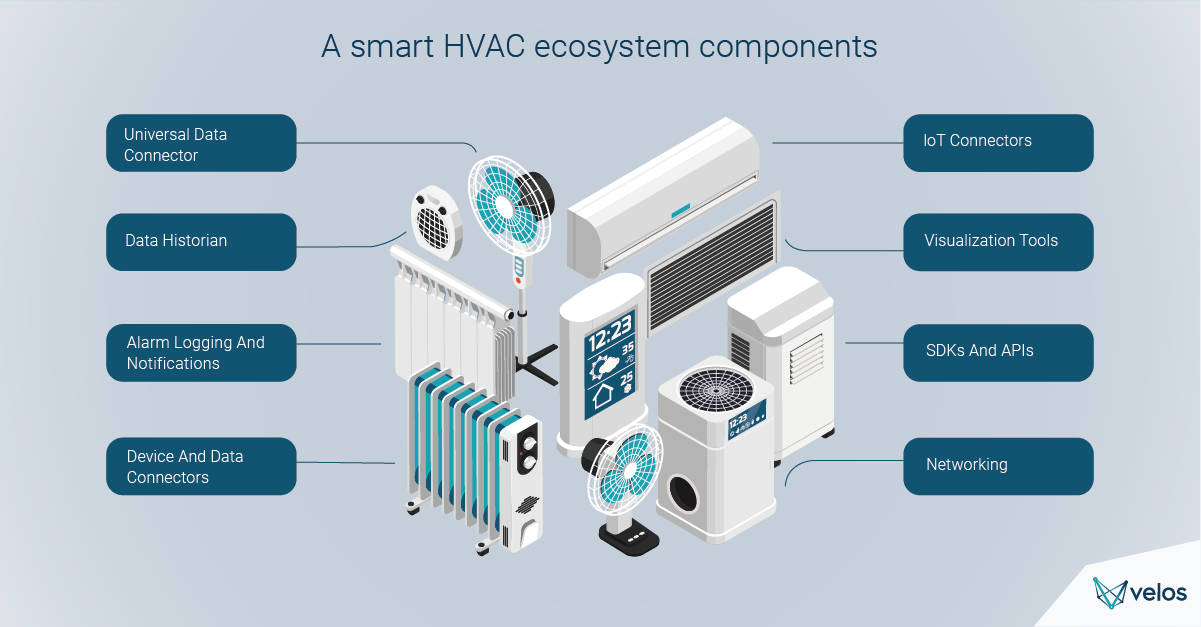
Top IoT HVAC applications
Preventative Maintenance:
Traditional HVAC maintenance methods, whether reactive or schedule-based, often lack real-time insights into system conditions. With IoT sensors, HVAC partners can adopt a condition-based approach to preventative maintenance. Real-time data gathered by sensors is transmitted to a cloud-based platform, allowing partners to remotely monitor system health. When anomalies such as reduced efficiency, excessive power consumption, or abnormal vibrations are detected, technicians can diagnose issues remotely. This proactive approach minimises downtime and reduces service costs.
Energy Efficiency:
IoT sensors installed on HVAC equipment enable real-time monitoring of energy consumption. Unlike legacy systems where energy usage data is only available after consumption, IoT provides instantaneous insights. These sensors can track usage trends, consider weather predictions, and regulate indoor climate control efficiently. The result is improved energy efficiency, reduced power consumption, and the potential integration of HVAC systems into IoT-enabled smart grids.
Remote System Monitoring and Control:
IoT transforms HVAC systems from working until failure to being continuously monitored and controlled. Through smartphone apps or web portals, homeowners, property managers, and HVAC partners gain remote access to detailed insights. Sensors can detect issues such as leaks, pressure variations, vibrations, temperature fluctuations, and more. This level of data granularity empowers technicians to accurately assess system status without being physically present, leading to quicker issue resolution and minimised downtime.
Regulatory Compliance:
Meeting regulatory compliance requirements is a significant aspect of HVAC businesses. IoT simplifies this process by providing real-time data recording and automated report generation. With continuous monitoring and data storage, HVAC systems equipped with IoT can streamline the documentation needed to prove compliance with environmental regulations. This reduces paperwork, ensures accurate record-keeping, and facilitates easier adherence to both government and corporate standards.
Recurring Service Plans:
IoT-enabled HVAC solutions enable a shift from traditional service models to more proactive and efficient recurring service plans. Partners can remotely monitor HVAC systems, ensuring that service calls are made only when necessary. This approach minimises unnecessary site visits, optimising resource allocation and reducing operational costs. Additionally, IoT facilitates the creation of usage-based pricing models, where customers are billed based on actual system usage. This can be bundled with service partners, providing HVAC partners with additional recurring revenue streams.
Considerations for Adoption
When considering the adoption of Smart HVAC systems, it’s essential to assess factors such as the initial investment, potential savings, and the specific needs. While the upfront cost may seem significant, the long-term benefits in terms of energy efficiency, comfort, and reduced maintenance expenses often outweigh the initial investment.
Future with smart HVAC
The digital era was all about building technology that makes lives easier and spaces smarter but right now there is a shift towards making the smart technology more accessible. One of the anticipated trends of smart HVAC includes a widespread adoption driven by increased affordability for residential and commercial users. Smart HVAC systems will further integrate with smart grids, contributing to overall energy efficiency and communication within interconnected environments.
It’s time to adopt smart HVAC
As we embrace innovations like smart HVAC, we not only experience greater convenience but also contribute to a more sustainable and efficient future. Whether it is residential or commercial, your HVAC system needs a reliable partner that knows the world of IoT and moreover has the network to turn your vision into a reality. Get in touch with our team of experts at Velos IoT and switch to smart HVAC.
Related Articles
With 20+ years of experience in delivering complex IoT services, we understand the importance of world-class connectivity and security. We enable businesses worldwide, including IoT connectivity providers, to build and manage their mission-critical devices.


